
Team building games cover very different formats, from a five-minute icebreaker in a meeting to a full day built around several challenges. Picking the right one has less to do with a list of ideas than with three practical constraints: the time available, the budget, and the venue where the team gathers. This guide groups the formats most used in companies by game type, then gives the benchmarks needed to arbitrate between them and organise them well.
Why organise team building games in a company
A team building game serves one precise purpose, team cohesion, by creating a situation where colleagues collaborate outside their usual work setting. Solving a puzzle, answering a quiz or taking on a physical challenge puts everyone on equal footing, regardless of role or seniority, which often brings out dynamics different from those seen in a regular meeting.
This kind of activity also answers very concrete organisational needs. A team that just onboarded several new hires, two departments that need to learn to work together after a reorganisation, or a hybrid team that only crosses paths occasionally at the office: in all three cases, a shared game speeds up the creation of common reference points that day-to-day work alone takes much longer to build.
The other benefit, less often mentioned, concerns communication. A well-chosen game forces people to exchange information, split roles and decide together under a time constraint, which mirrors on a small scale mechanisms useful to collective work. It is also a concrete argument for bringing employees back to the office : pairing physical presence with a shared, enjoyable moment makes the commute easier to justify than a string of ordinary meetings.
The format chosen still needs to genuinely fit the team and the moment. A game that runs too long will lose a time-pressed team, and an overly competitive game can make a group that does not yet know each other uncomfortable. The sections below detail the families of games most commonly used, grouped by the time and equipment they require.
Investigation games and puzzles to solve as a team
Investigation games form one of the most popular families of team building, carried along by the wider success of the escape room. The shared principle: a team has a limited time to solve a series of puzzles or piece together a plot, which forces role-splitting and the fast pooling of clues found by each member.
The escape room remains the best-known format. Booked for a fixed duration, often away from company premises, it works in small teams of four to six people who must get out of a room or solve a plot before time runs out. Its strength is putting everyone at the same level in front of an external constraint, which limits the implicit hierarchies that sometimes creep into other game formats.
The murder party takes the investigation further, giving each participant a role and partial information to share in order to solve a scenario. This format demands more preparation, a written scenario and sometimes a dedicated host, but it sustains engagement for longer than a classic escape room and suits a half-day offsite well.
The treasure hunt, indoors or outdoors, uses a simpler mechanic: a series of clues lead from one point to the next until a final objective. Its flexibility makes it easy to adapt to the office, using existing spaces as the playing field, or to the outdoors for a more ambitious, neighbourhood-scale format.
These three formats share one point in common: they almost always require some preparation or the involvement of a specialised provider, which makes them better suited to a one-off event than to a recurring monthly activity.
Quick, no-equipment games for an office
Not every team building game needs a budget or a trip away from the premises. Several formats can be played in minutes, with no equipment, straight in a meeting room or at the start of a team meeting, which makes them good candidates for a regular practice rather than a one-off.
The team quiz is the simplest example: a handful of questions prepared in advance, about the company, a current topic or the team members themselves, is enough to create a playful moment with no other logistics than a set of questions. The musical blind test follows the same logic, with song clips for teams to guess, and works particularly well as an end-of-day moment of relaxation.
The two truths and a lie game remains an icebreaker classic: each participant states three statements about themselves, one of them false, and the rest of the group must guess which one. Simple to explain, it works as well for a team that already knows each other as for onboarding new hires.
More unexpected, the paper aeroplane game has each team design and fly the best-performing model against a criterion set in advance, distance or accuracy. This format needs only paper, wraps up in about ten minutes and works particularly well to lighten a meeting that just covered a dense topic.
These short formats share a decisive advantage: they need no venue booking and no budget, which makes them accessible to any team, including those with no dedicated events budget.
Outdoor team building games and activities
Outdoor formats change scale: they generally gather a larger group, over a longer period, and favour physical activity or collective staging over pure problem-solving.
The urban rally applies the treasure hunt principle at the scale of a neighbourhood or a city, with challenges spread across a route that teams follow at their own pace, often guided by an app or a route sheet. It suits a large group split into several competing teams well.
Company olympics pick up the spirit of amateur sports competition, with several short challenges that require no particular athletic skill, designed so every participant can contribute regardless of physical level. This format works particularly well for a full offsite day, alternating challenges with shared breaks.
Collective building exercises outdoors, such as putting up a structure with limited materials or carrying a fragile object as a team under constraint, put the emphasis on coordination rather than individual performance. They are easy to run in a park or garden, with no heavy setup required.
These outdoor formats generally require more logistical organisation, transport, weather, shared equipment, which explains why they are most often reserved for an annual or biannual event rather than a recurring practice.
How to choose a game by budget, group size and duration
Picking the right format rarely comes down to personal preference: it almost always follows from crossing three constraints, the time genuinely available, the number of participants and the budget allocated to the event.
| Constraint | Suitable formats | Formats to avoid |
|---|---|---|
| A few minutes, no budget | Quiz, icebreaker, two truths and a lie | Escape room, urban rally |
| One to two hours, limited budget | Paper aeroplane, blind test, office treasure hunt | Company olympics, murder party |
| Half a day, dedicated budget | Escape room, outdoor treasure hunt | Few-minute-only formats |
| Full day, offsite | Company olympics, murder party, urban rally | Games designed for a single break |
The number of participants also directly shapes the game mechanic more than the game itself. Most formats naturally break down into small teams of four to eight people, which makes it possible to host a large group simply by multiplying the number of teams rather than changing the game. Puzzle-based formats benefit from staying on tighter teams, so everyone keeps an active role, while sports or outdoor formats absorb a large headcount more easily.
Budget, finally, mostly separates self-run formats from those run by a provider. A team building budget broken down by format and per person helps frame this arbitration before choosing, especially when several teams or several sites must be accounted for in the same event. A provider-free format, such as a quiz or an icebreaker, remains the simplest solution when no budget line has been planned.
Where to organise team building games in the company
The venue shapes the choice of game as much as budget or duration do. Short, no-equipment formats can be played directly in the company’s existing spaces, with no booking or special setup: a break-out corner, an open space between two meetings, or a meeting room freed up for the occasion are more than enough.
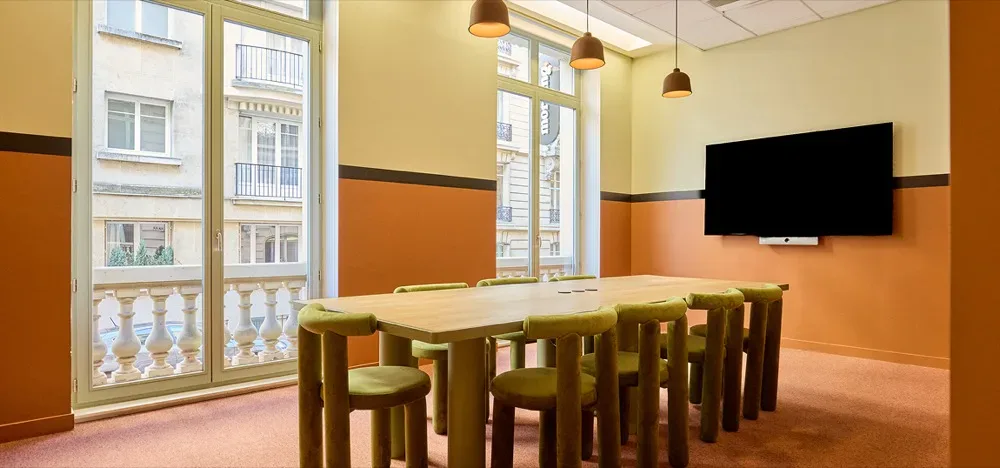
For a more structured format, such as a murder party or a workshop built around several parallel teams, designing a meeting room able to comfortably host everyone becomes a real criterion: circulation between tables, decent acoustics so groups do not disturb each other, and modular furniture to reconfigure the space between challenges.
When the format takes on the scale of an offsite, a full day or several challenges chained together, hiring a private venue for an offsite offers more room to manoeuvre than a simple office: dedicated space with no noise constraint towards other teams, capacity matched to the number of participants, and logistics designed to run several activities back to back on the same day without reorganising the company’s usual premises between each challenge.
Frequently asked questions about team building games
What is the simplest team building game to organise?
An icebreaker or a no-equipment team quiz comes first: it takes minutes to prepare, needs no budget or provider, and works as well in a meeting room as on a video call. It is the format to favour for a first attempt or to punctuate a meeting without spending half a day on it.
How long should a team building game last?
It depends entirely on the goal. An icebreaker in a meeting takes a few minutes. An investigation-style game such as an escape room or a murder party usually runs one to two hours. An outdoor format with several challenges can fill half a day, and a full offsite often combines several games across an entire day.
Can a team building game be organised with no budget?
Yes, several formats need no specific equipment or external provider: a homemade quiz, an icebreaker, two truths and a lie, or small puzzles built in-house. They rely on an organiser’s preparation rather than an investment, making them a good starting point before considering a paid format.
Which team building games work for remote or hybrid teams?
Short formats that do not involve handling physical objects transpose best to video calls: quiz, blind test, a question-by-question icebreaker, or small puzzles solved in breakout rooms. Games that require moving a physical object or sharing the same venue, such as a classic treasure hunt, translate poorly to remote settings.
How many people are needed to organise a team building game?
Most formats scale to a small or a large group, as long as the number of teams is adjusted. An icebreaker or a quiz works from four to five participants upwards. Puzzle-based or outdoor formats give their best with teams of four to eight people, which allows the group to multiply teams rather than lose momentum.