Costing a team building almost always starts with the same question, asked the wrong way round: what overall envelope to set aside. The right unit of measurement is the cost per participant, because it is the only one that stays comparable from one format to another and from one year to the next. Here are the ranges actually practised on the market, the breakdown cost centre by cost centre, and the variables that move a team building budget from 40 to 250 € per person for events that look identical on paper.
What the budget really covers
A team building is not a single service but an assembly. Depending on the case it includes an activity, a venue, a meal, materials, coordination, sometimes travel and accommodation. Two quotes showing the same amount can therefore cover completely different scopes.
This is the first source of unpleasant surprises. A rate advertised “from 35 € per person” almost always refers to the activity alone, venue and catering excluded. Once those two lines are added, the total at least doubles. Before any comparison, the list of what is included and what is excluded has to be established line by line.
The second useful reflex is to separate fixed costs from variable costs. A private venue, a technical crew and coordination are fixed costs: they are spread over the number of participants. A meal, a workshop kit or a travel ticket are variable costs: they follow headcount unit by unit. That distinction drives the whole logic of volume discounts.
Per-person ranges by format
The rates observed on the French market fall into four consistent tiers, from the lightest to the most committing.
| Format | Budget per person | What is usually included |
|---|---|---|
| Standalone activity, 2 to 3 h | 30 to 120 € | Activity and facilitator, no venue or meal |
| Turnkey half-day | 40 to 90 € | Activity, coordination, room, break |
| Full day | 100 to 250 € | Private venue, activity, lunch, coordination |
| Day plus evening | 120 to 280 € | Full day, dinner and evening entertainment |
| Two-day offsite, one night | 250 to 600 € | Day, accommodation, two main meals, transfers |
Indicative ranges built from public rates collected on 7 September 2026 on https://www.eventdrive.com , https://team-break.fr and https://www.funbooker.com . Those figures should be checked against real quotes, which depend on the date, the city and the headcount.
The densest band sits between 50 and 150 € per person. That is where the majority of half-day and full-day corporate events concentrate, with a frequently quoted reference point around 50 to 60 € excluding tax per participant from about twenty people upwards for a simple format.
The four cost centres
The venue
Plan for 15 to 80 € per person per day for a private space, depending on the city, the surface area and the level of equipment. It is the most elastic line, and the one where sharing works hardest: the same space costs half as much per head with forty participants as with twenty.
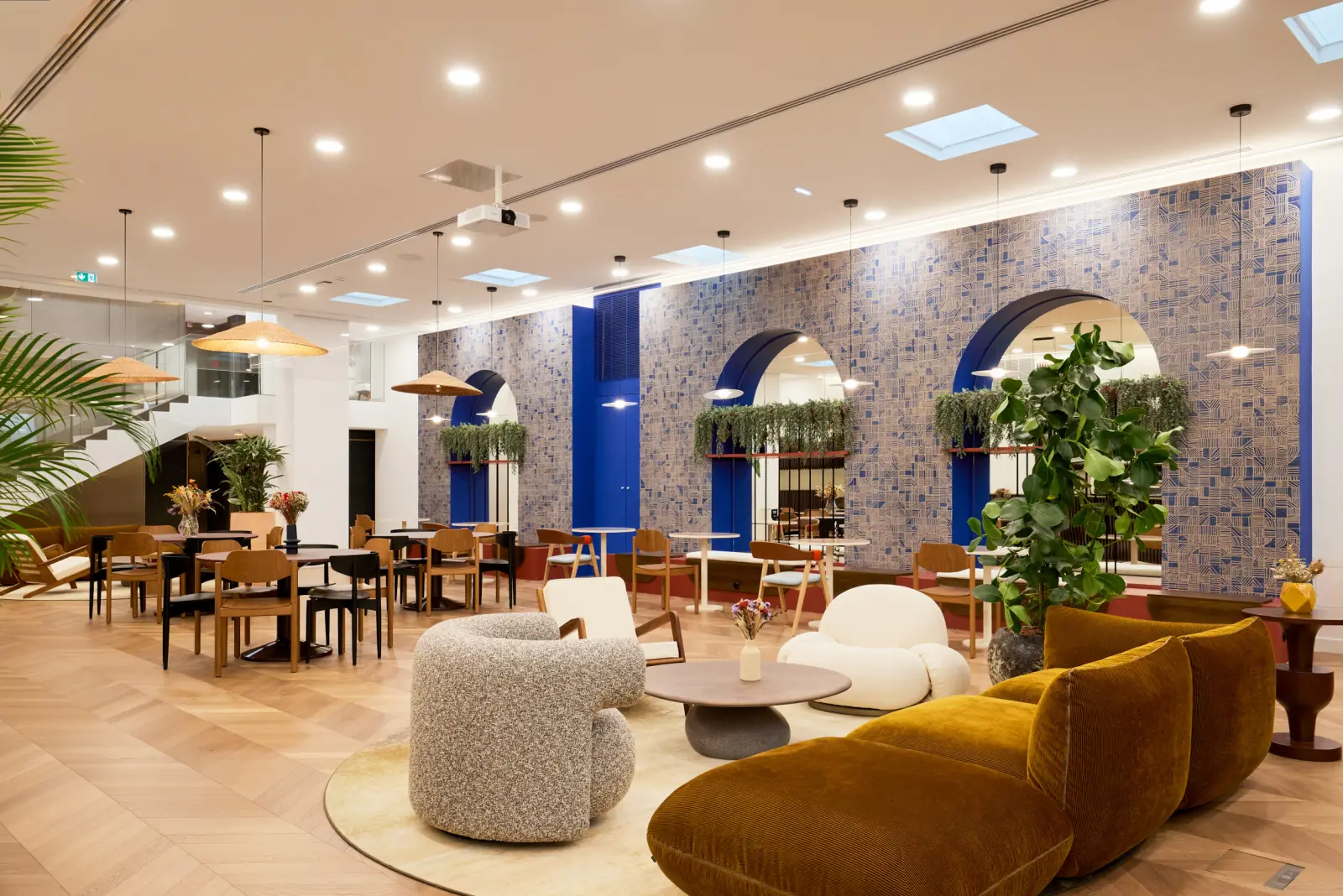
A venue already fitted with modular furniture, projection and sound removes an entire technical rental line. The criteria that separate a usable space from a space still to equip are detailed in our analysis of meeting room design .
The activity
From 30 to 120 € per person when billed per participant. A creative workshop sits closer to 40 to 85 €, a cooking workshop to 50 to 100 €, with an observed average around 75 €. Billed as a flat fee, a professional facilitator lands between 300 and 800 € per day: that billing mode becomes clearly more advantageous beyond roughly thirty participants.
Catering
A caterer lunch sits between 25 and 45 € per person, a seated dinner rarely below 60 €. Coffee breaks add 5 to 10 €. It is the most rigid line in the budget, since it follows headcount to the exact participant and benefits from no real volume discount.
Logistics and coordination
Travel, accommodation, printed materials and coordination make up the remainder. Accommodation sits between 80 and 180 € per person per night, communication materials between 5 and 15 € per participant. Coordination, when entrusted to a provider, is expressed as a percentage of the total budget.
Sources: rate cards published by Eventdrive and Team Break, collected on 7 September 2026.
What makes the invoice move
Five variables explain most of the gaps between two quotes.
Group size first, with an efficiency band between 20 and 60 participants: below it, fixed costs weigh too heavily per head; above it, logistics get more complex and the activity has to be split in two. Location next, which mainly affects venue and travel. Then timing, with pressure peaks in the back-to-school months and at the end of the year, periods when private hire costs more and slots are booked months in advance.
The level of customisation also matters: a bespoke activity, with a scenario written for the company, is billed well above an off-the-shelf format. Finally the expected level of service, which covers catering quality, set design and the presence of a technical crew.
Paris or the regions, the real gap
The comparison is often framed badly. On the venue line alone, a Parisian space does cost more than a regional equivalent. But the reasoning reverses as soon as travel and journey time are included.
For a Paris-based team, a regional event adds tickets, often a hotel night, and above all half a working day lost in transit for every participant. The full cost frequently catches up with a Parisian format, with heavier organisation on top. Price benchmarks by district are set out in our analysis of coworking prices in Paris , which gives a useful order of magnitude for pricing private hire.
A team building that overruns its budget almost always overruns on the same line: catering, because it is the only one that cannot be shared. It is also the one costed last.

For a one-day format with a Paris-based group, hiring a space in the city remains the clearest scenario from a budget point of view. The terms and the points to watch are detailed in our guide to private hire of a venue for an offsite , and the available spaces are presented on the Morning events pages .
Building the budget in the right order
The sequence that avoids emergency trade-offs comes down to five steps.
- set the expected headcount and the chosen format, before any provider search;
- cost the four centres separately, separating fixed costs from variable costs;
- request two or three quotes on a strictly identical scope, line by line;
- add a reserve of 5 to 10 % for last-minute adjustments;
- check the cancellation terms and the minimum number of participants billed.
That last point is the one most often overlooked. Many providers apply a floor of 15 to 20 billed participants whatever the headcount actually present, along with cancellation penalties that climb as the date approaches. On an event at 100 € per person, an attendance rate of 70 % turns a controlled budget into a 40 % overrun on the cost per participant actually there.