
Sports team building brings a team together around a shared physical activity, away from the usual meeting rooms. This format is gaining ground in corporate seminars, as it combines cohesion, physical exertion and a social moment, with formats accessible to both large groups and small teams.
Comparing sports team building formats
| Format | Participants | Duration | Fitness level | Main objective |
|---|---|---|---|---|
| Corporate olympics | 10 to 200+ | Half-day to full day | Accessible to all | Cohesion through mixed teams |
| Multi-sport tournament | 10 to 60 | Half-day | Accessible to all | Team spirit, pushing limits |
| Orienteering | 8 to 100 | Half-day | Moderate | Autonomy and mutual support |
| Outdoor challenge (tree climbing, canoeing) | 8 to 40 | Half-day to full day | Moderate to intense | Pushing limits, change of scenery |
| Collective yoga or Pilates | 6 to 50 | 1 to 2 hours | Accessible to all | Well-being and active relaxation |
This comparison gives an order of magnitude: duration and group capacity vary according to the provider and the venue chosen.
What is sports team building?
Sports team building is a corporate seminar or activity organised around sport, aimed at team cohesion rather than individual performance. It differs from a simple corporate sports class through its organisation in mixed teams, blending departments and hierarchical levels, and through a format designed to foster exchange as much as physical effort.
The format suits a small team of 10 people just as well as a large group of several hundred employees, and adapts to every fitness level by combining accessible collective activities with more intense challenges for volunteers.
This format also stands out through the setting chosen: an equipped indoor room is enough for a skill-game tournament or a collective yoga session, while an orienteering course or an outdoor challenge calls for outdoor space, or even a trip outside Paris for a full day. The choice of setting therefore comes after the choice of activity, depending on the time and budget available.
Why organise sports team building in your company?
Stepping outside the usual professional setting remains the primary goal sought. A shared sports activity creates common memories and opportunities for mutual support that a meeting cannot generate, especially between teams that rarely work together day to day.
Physical activity also has a direct effect on well-being at work: it reduces stress and improves sleep quality and concentration in the days that follow. For a company, adding a sports element to its seminar often fits into a broader approach to quality of life at work, or even CSR when the chosen activity has a charitable dimension (collection drive, charity run, beach clean-up).
Sports team building finally eases internal communication between employees who do not necessarily cross paths on the org chart: a manager and an intern find themselves on equal footing on an orienteering course or in the same olympics team. This mix works particularly well for a growing company, where new hires regularly join already-formed teams, or after a merger of departments that have not yet had the chance to work together.
What sports activities to suggest for team building
The choice of activity depends on the group’s average fitness level, the time available and the venue chosen. The most unifying formats remain accessible to all, with more demanding variants for volunteers.
Corporate olympics break down into several short events (relays, tug of war, skill games) in mixed teams, with a points-based ranking that keeps up the excitement without singling anyone out on a single discipline.
The multi-sport tournament rotates teams through several team sports on the same day (football, volleyball, basketball), which limits fatigue from a single effort and lets everyone find a sport where they feel comfortable.
Orienteering combines physical effort and puzzle-solving in small autonomous groups, a format that values strategy as much as fitness and suits teams who enjoy solving challenges together.
Outdoor challenges, such as tree climbing or canoeing, offer a stronger change of scenery and suit full-day seminars, with travel time to factor in depending on the venue chosen.
Collective yoga or Pilates offer a gentler approach, focused on well-being and active relaxation rather than performance, a useful format to open or close a seminar without over-taxing the group.
How to organise sports team building, step by step
1. Define the objective. Cohesion between teams that rarely work together, onboarding new hires, or a moment of decompression after a busy period: the objective shapes the choice of format and its intensity.
2. Set the duration and headcount. A half-day suits most olympics and tournaments, a full day suits outdoor challenges that involve travel. The number of participants then determines how many teams and parallel activities to plan.
3. Choose an activity accessible to every fitness level. A good sports team building format includes an accessible version and a more intense version of the same event, so no one feels excluded because of their fitness level.
4. Book a suitable venue. The space must offer enough room for the planned activities, easy access for all participants, and ideally a water point or changing rooms for the most physical formats.
5. Plan a social moment after the activity. A meal or a shared drink right after the activity extends the exchanges born during the sport and anchors the group’s shared memory of the seminar.
The season also affects the choice of format: outdoor activities are easier to plan between April and October, while an indoor tournament or a collective well-being session remains feasible year-round. Planning a covered backup option for an outdoor activity avoids cancelling a seminar booked well in advance in case of bad weather.
Where to organise sports team building in Paris
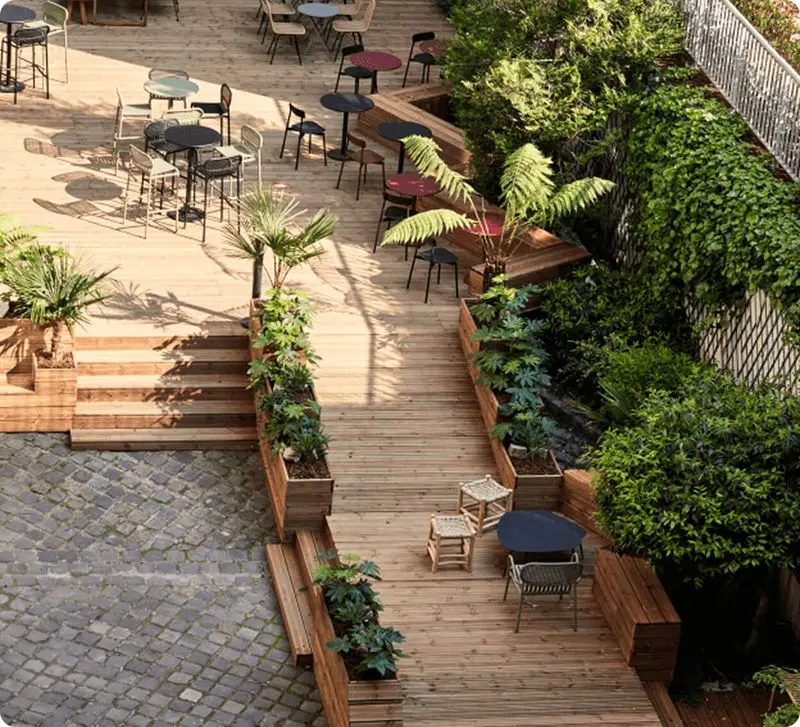
The choice of venue shapes much of the logistics: access for a large group, outdoor space for physical activities, a backup room for the briefing and the social moment that follows the effort. A terrace or a landscaped garden in the heart of Paris makes it possible to organise outdoor challenges without leaving the city, an advantage for teams with limited time.
Morning offers several Paris addresses dedicated to corporate events, with modular spaces suited to sports seminars as well as more classic formats. For a budget estimate, the guide to team building budget breaks down spending items by format and headcount. To find more activity ideas, including indoor ones, the article on team building games complements this guide with formats that need no sports equipment. And to compare options for hiring a dedicated venue, the guide to hiring a venue for a seminar details the criteria to check before booking.