Bringing employees back to the office has become a recurring subject in management committees, often posed as a binary question: how many days, and how do we enforce them. Put that way, it almost always produces the same outcome, a rule that is announced, worked around, then quietly abandoned. The figures show something else: what brings teams back is not the requirement itself, it is what they find on site that they do not have at home. Here is what the data says, which levers actually work, and which ones consistently fail.
What the figures say, before deciding anything
The first useful piece of information is that the subject is far less unstable than the debate suggests. In a survey published in March 2026, Apec reports that 94% of companies plan no change to their remote work policy this year, after 89% that had made no change the previous year. Arrangements have settled, and mass return-to-office campaigns remain a minority.
Remote work rhythms have stabilized too. The average pace sits at around 1.9 days a week, down from 2.7 in 2021. Around 22% of private-sector employees work remotely at least once a month, and nearly three managers in four do so at least half a day a week. These figures matter because they turn the question upside down: the aim is no longer to bring people back to an imagined pre-2020 baseline, it is to make the most of the days already spent on site.
Why bring them back, beyond the principle
Companies that do tighten their arrangements give reasons that are mostly relational. According to the same Apec survey, 38% cite recruitment and integrating new joiners, 33% employee engagement, and 23% limiting departures. Almost none of them cite direct productivity, which is a useful signal: the measurable gain does not lie in individual output but in what gets transmitted between people.
That explains why a return policy only produces effects when the days are shared. Bringing five people back on five different days changes nothing to onboarding, learning by imitation or cross-team exchange. Bringing the same five people back on the same day changes all three.
What does not work: constraint without counterpart
This is the clearest finding from the field. Companies that tightened their policy without changing anything about working conditions report dissatisfaction rates of 74 to 80% among the employees concerned. The rule is applied on paper, then eroded: medical appointments, exceptional days, tolerated arrangements. Six months later, actual attendance is back at its starting point, with the trust cost on top.
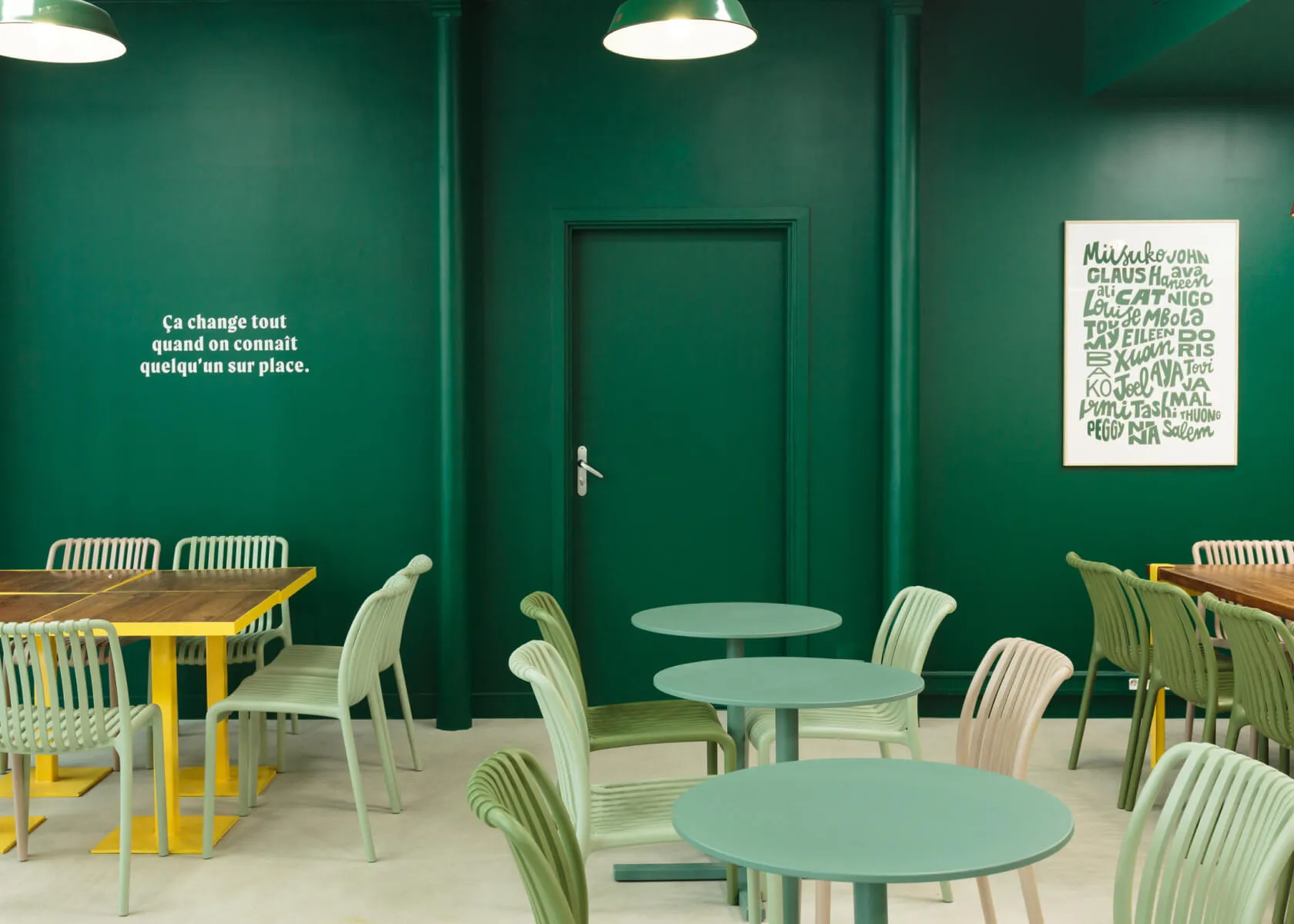
The second mistake is to bet on peripheral services. Parcel lockers, a food truck, a sports class, a coffee bar: all are appreciated once people are on site, none of them is the reason they came. Employees who do come in name two drivers, the presence of their team and the ability to work properly, well ahead of any perk.
| Lever | Observed effect | Implementation cost |
|---|---|---|
| Collective anchor day per team | Strong, drives actual attendance | Low, organizational only |
| Individual day quota | Weak, applied then eroded | Low, but high trust cost |
| Enclosed spaces and acoustic treatment | Strong on the decision to travel in | Medium to high depending on the site |
| Services and perks | Marginal as a trigger, positive once on site | Low to medium |
| Relocating to a better-served site | Strong, especially on commute times | High, tied to lease expiry |
Indicative benchmarks, to be adjusted according to the size of the organization and the geographical spread of teams.
Set anchor days rather than an individual quota
The most effective arrangement is also the simplest to state: each team shares one or two fixed days on site, set by the team itself rather than imposed from the top. The individual quota, three days a week for everyone, produces the opposite effect, since each person picks the days that suit them and encounters happen by chance.
The anchor day also has a practical advantage: it makes floor sizing predictable. Attendance already concentrates on Tuesday, Wednesday and Thursday in most organizations. Spreading anchor days across teams smooths the midweek peak instead of amplifying it, and mechanically relieves rooms and desks on the fullest days.
Make the office usable for working, not only for meeting
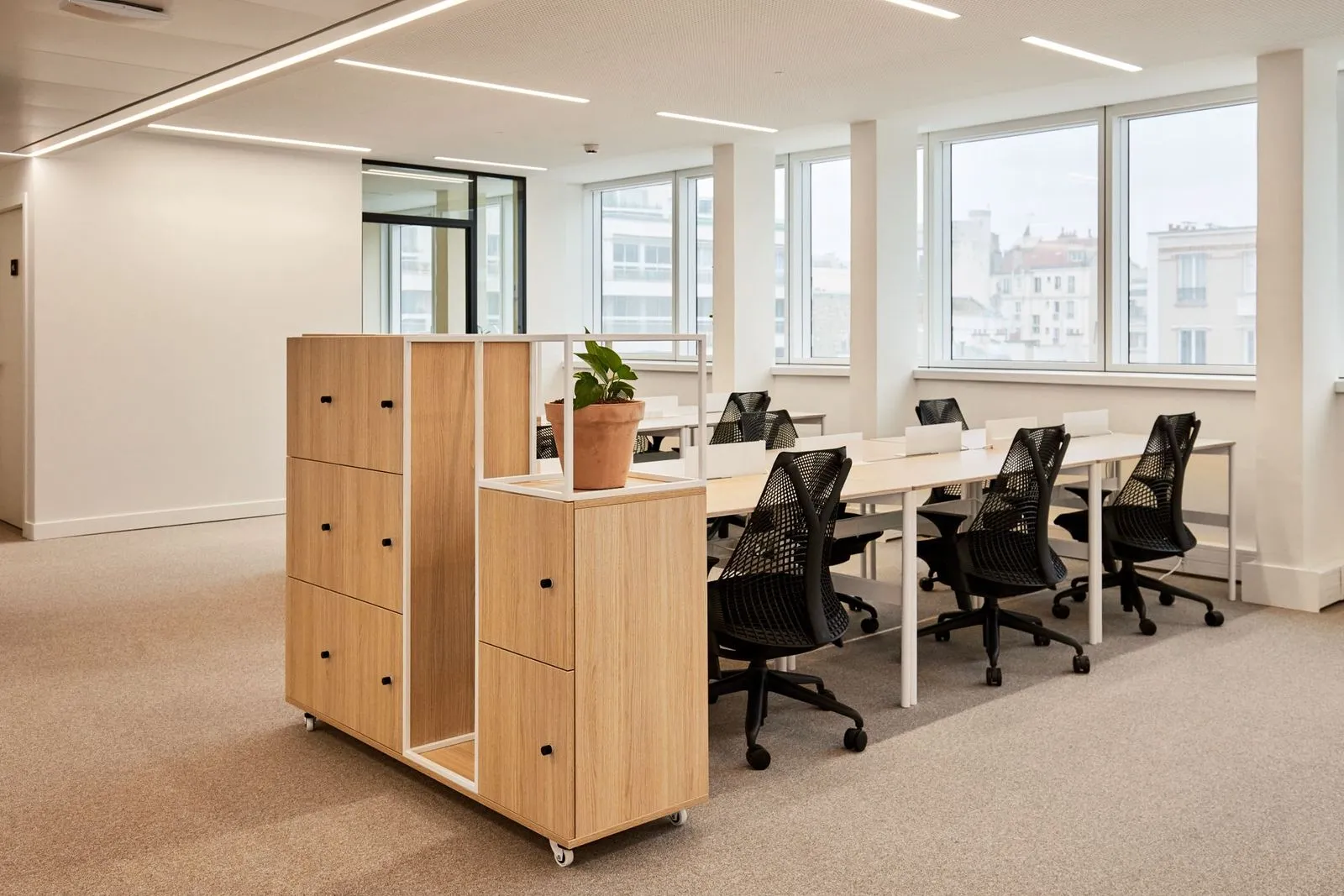
Layout is the other half of the equation, and it is often the neglected half. An IFOP survey conducted for Sonos shows that 71% of people working in open environments consider noise disrupts their concentration. That is, very concretely, the first reason given for staying home: nobody travels an hour to work worse than at their kitchen table.
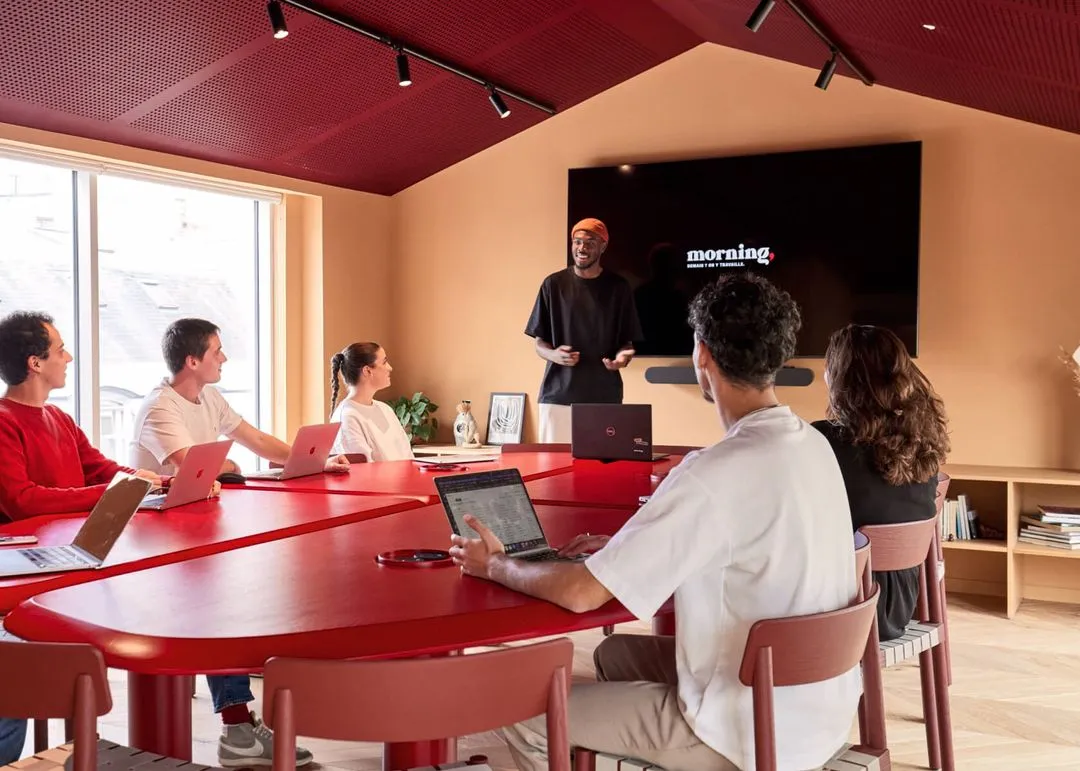
Which means the return-to-office question intersects the layout question. The arbitration between private office and open space is now settled on concentration criteria rather than status, and meeting room design includes acoustic treatment from the outline stage, precisely because hybrid meetings expose every flaw from the first video call.
The real question is not how many days teams should come in, but what they find at the office that they do not have elsewhere. As long as the answer is a noisier desk and the same video calls, no rule will hold. Once the answer is their team, enclosed rooms and equipped spaces, the rule becomes almost unnecessary.

Size on peaks, not on averages
A floor calibrated on weekly average attendance saturates three days out of five and sits empty the other two. That is the most common sizing mistake, and it directly undermines any return policy: teams asked to come back find no seat, no free room, no quiet corner.
The workable approach is to size on midweek peaks, with a ratio of around 0.7 desks per person and enough enclosed spaces alongside. Flex office only works on that condition, otherwise it turns into a daily hunt for a seat. To check an order of magnitude before arbitrating, Morning’s desk calculator gives a first estimate.
Measure before arbitrating
Two indicators are enough to settle most debates. The first is the occupancy rate measured on peak days, over several complete weeks: it says whether the floor can absorb an increase in attendance or whether it is already saturated. The second is the room booking refusal rate, which reveals a shortage of enclosed space that no desk count will show.
These two figures replace a large share of internal opinion. They also allow a policy to be adjusted without reopening the principle: when the refusal rate stays high, the answer is more rooms, not more mandatory days.
Where to start
The order matters more than the ambition. Start by setting collective anchor days team by team, which costs nothing and acts on the main driver. Then measure actual occupancy on those days over a full quarter. Only then arbitrate on layout: acoustics first, enclosed rooms next, everything else afterwards.
If measurement shows that the site itself is the obstacle, commute times, access, saturation, the question shifts to the location, and choosing the district becomes the most structuring decision. Comparing a coworking price per desk in Paris with the full cost of a current floor often gives a clearer picture than expected, and the office rental offers help set a realistic budget before making any move.