
A modern meeting room is no longer defined by its furniture but by its ability to host both in-person discussions and hybrid meetings with remote participants. Screen, camera, microphone and connectivity now matter as much as the table and chairs. Here are the concrete criteria for recognizing, equipping or choosing a modern meeting room, whether for an in-house fit-out or a rental.
What is a modern meeting room?
A modern meeting room differs from a traditional one in three main ways. The first is built-in technology: a display or touchscreen, a camera and a microphone designed for video conferencing rather than bolted on afterward. The second is flexible layout, with mobile furniture that lets the space be reconfigured depending on the type of meeting. The third is overall comfort, designed for sessions that sometimes run past an hour: proper acoustics, even lighting and connectivity accessible right from the table.
This shift is a direct response to the spread of hybrid work. A room designed only for people seated around a table no longer works once part of the team joins remotely. Designing a modern meeting room therefore starts with the screen and the camera, and only then moves on to furniture and decoration.
How much space and capacity should be planned?
Floor area remains a baseline factor, even in a well-equipped room. The common rule is about 2 m² per seated person, excluding circulation space and the technical area around the screen.
| Capacity | Indicative usable area | Minimum technology equipment |
|---|---|---|
| 2 to 4 people | 8 to 10 m² | Screen, webcam, built-in microphone |
| 6 to 8 people | 14 to 18 m² | Screen, wide-angle camera, table microphone |
| 10 to 12 people | 22 to 26 m² | Large screen, tracking camera, multiple microphones |
Benchmarks for a seated working setup, excluding training or conference rooms.
The most requested format in today’s equipped offices is for four to six people, for short and frequent team meetings. For more detail on sizing and layout rules, including acoustics and lighting, a dedicated guide on meeting room design covers each criterion.
What technology equipment should be installed?
Technology equipment is the core of a modern meeting room. Four elements consistently appear in recent projects.
The screen comes first, whether a simple display or an interactive touchscreen that allows annotating a document during the meeting. Its diagonal size should stay readable from the farthest seat, roughly a sixth of the viewing distance.
The camera comes next, ideally wide-angle and positioned under the screen at face height, to cover every participant without anyone being cut off or seen in profile. Recent models include automatic tracking that reframes the image on whoever is speaking.
The microphone needs to cover the whole table: beyond six to eight participants, a microphone built into the screen is no longer enough, and a multi-capsule system becomes necessary to keep voices audible on the remote side.
Wireless screen sharing completes the setup, avoiding a tangle of cables and adapters on the table. Combined with easy support for flex office and remote work, it lets anyone connect their laptop within seconds, without going through IT.
How should acoustics and comfort be handled?
A perfectly equipped room remains unusable if acoustics are ignored. Two phenomena affect perceived comfort. Internal reverberation comes first: in a room with bare walls, voices bounce and overlap, which tires listeners once a meeting runs past thirty minutes. Absorption, through wall panels, a rug or fabric furniture, solves most of the issue.
Sound isolation from the outside comes next: a glazed room with no treatment lets conversations leak out and lets floor noise in. A solid door rather than a glass one, along with double glazing, limits this leakage, which is particularly useful in an open-space layout.
Lighting plays a similar role for video call comfort. Indirect, even lighting around 400 to 500 lux avoids the harsh shadows on faces caused by spot lights placed directly above the table.
Furniture and layout: how to organize the space
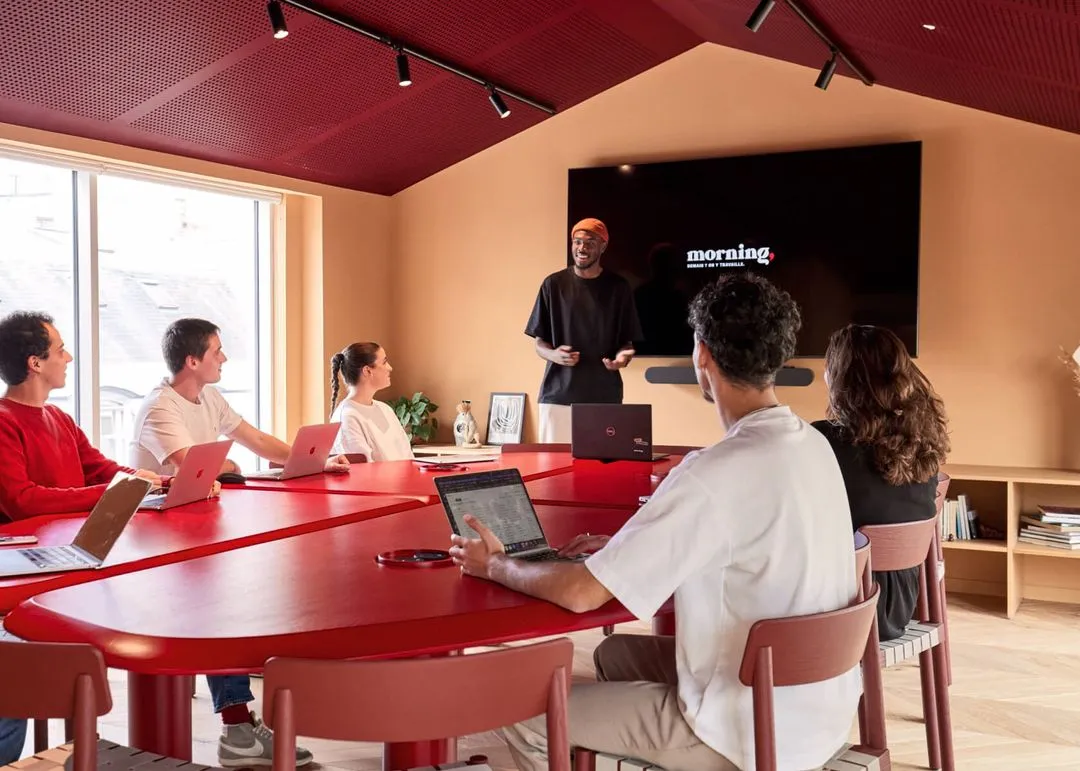
Furniture choices follow the room’s main use, not the other way around. For a working meeting with fewer than eight people, an oval or round table encourages exchange since everyone can see the whole group. For a presentation setup facing a screen, a rectangular or U-shaped arrangement works better.
The layout should also plan for cable routing and power outlets accessible directly from the table, to avoid trailing extension cords on the floor. A whiteboard or a writable wall often completes the equipment, useful for collaborative work even in a highly digitized room.
Seating, finally, deserves the same attention as at a regular desk: a chair with proper lower-back support becomes essential once meetings run past an hour, a point also raised in our office design trends 2026 coverage of comfort at the workstation.
Modern meeting room: renting in a business centre or coworking space
Not every company benefits from fitting out a modern meeting room in-house. For occasional, irregular use or to cover an activity spike, hourly or half-day rental in a business centre avoids the upfront investment in screens, cameras and furniture, as well as their maintenance and replacement.
A coworking space usually offers several formats of modern meeting rooms, already equipped and bookable directly from an app. This flexibility suits growing teams in particular, who don’t yet know exactly how many rooms or what capacity they will need.
For a company with daily, regular use by a fixed team, fitting out a dedicated room generally remains more cost-effective in the medium term, provided the equipment is chosen carefully from the start rather than upgraded piece by piece.
Frequently asked questions
How much space does a modern meeting room need?
The usual benchmark is about 2 m² (21 sq ft) per seated person, excluding circulation space. A room for six people therefore needs around twelve usable square meters. A modern meeting room also leaves clear space in front of the screen, so the video conferencing camera can properly frame every participant.
How should a modern meeting room be laid out?
Layout follows the room’s main use: an oval or round table for collaborative work, a U-shape or classroom setup for a presentation to an audience. The screen and camera go on a clear central wall, never facing a window, which would backlight faces during video calls.
What technology equipment should a modern meeting room have?
The baseline equipment is a touchscreen or a simple display screen, a wide-angle camera, a microphone that covers the whole table, and wireless screen sharing. Beyond eight participants, a multi-capsule audio system becomes necessary to keep voices audible for remote attendees.
How should meeting rooms in an office be named?
Companies most often pick a theme that matches their identity: cities, neighborhoods, colors or inspiring figures rather than plain numbers. What matters most is clarity: a short name, easy to remember and to spell out loud, that avoids any confusion when booking a room.
Should a company rent a modern meeting room rather than fit one out itself?
It depends on how often the room is used. For occasional or variable needs, hourly rental in a business centre or a coworking space avoids the upfront investment in equipment and its upkeep. For daily use by a fixed team, fitting out a dedicated room usually remains more cost-effective in the medium term.