
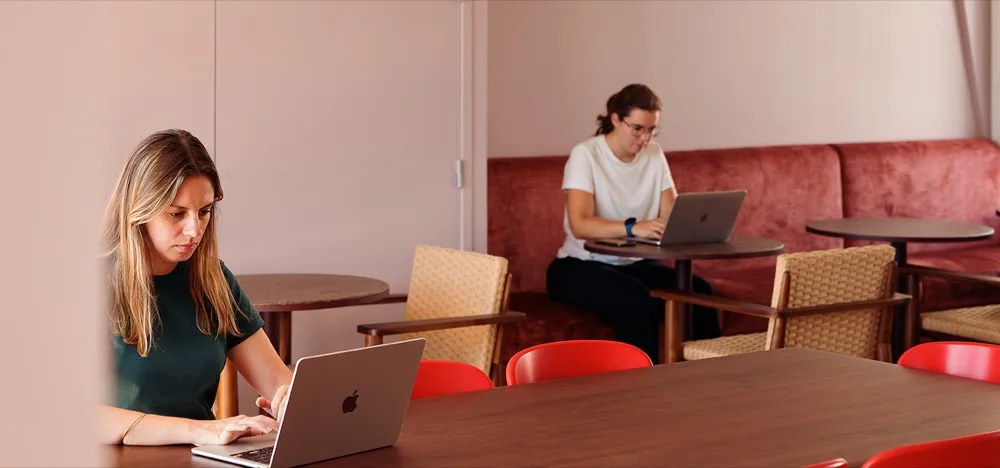
Deep work is the ability to work on a demanding task without the slightest interruption, for an extended period. Popularised by American computer scientist Cal Newport, the concept addresses a difficulty most office environments face today: sustaining long concentration on a single subject, increasingly rare amid constant notifications and demands on attention. This guide covers its definition, the method for practising it and the physical conditions that make it possible at the office.
Deep work vs shallow work: what is the difference
Cal Newport consistently contrasts deep work with shallow work, superficial tasks. This distinction helps identify, within a working day, what genuinely belongs to one register or the other.
| Criterion | Deep work | Shallow work |
|---|---|---|
| Type of task | Cognitively demanding work | Administrative or repetitive task |
| Concentration required | Continuous, uninterrupted | Fragmented, tolerates breaks |
| Example at the office | Writing a strategic report, designing a complex feature | Answering emails, attending a short status meeting |
| Value produced | A result that is hard to reproduce quickly | A task that is easily replaceable or automated |
An effective working day does not aim to eliminate shallow work, which remains necessary for a team’s day-to-day running, but to set aside dedicated slots for it so that deep focus time stays protected rather than letting the two blend continuously.
What is deep work?
Deep work is a state of intense concentration that pushes cognitive capacity to its limit on a single task, with no email checking and no switching between subjects. Cal Newport formalised the concept in his book Deep Work: Rules for Focused Success in a Distracted World, published in 2016, starting from the observation that this capacity is becoming rarer as digital tools fragment attention.
In this framework, deep work produces value that shallow work cannot offer: a creative or technically accomplished result that requires a period of immersion which repeated interruptions make impossible to reach. Cal Newport identifies four broad philosophies for organising focus time. The monastic philosophy isolates the person from all outside demands for long stretches, a model reserved for roles or positions that allow it. The bimodal philosophy splits the week or month between whole blocks set aside for deep focus and others left open for everyday exchanges. The rhythmic philosophy builds a daily habit at a fixed time, often early in the day, turning deep work into a routine rather than a one-off effort. The journalistic philosophy, finally, consists of switching into deep focus whenever a free slot appears during the day, a more demanding approach that already requires a solid grasp of the discipline.
Why deep focus is declining in offices
Several factors explain why deep work is becoming scarcer in today’s professional environments. Instant messaging and constant notifications create an implicit expectation of a quick reply, which pushes people to keep an eye on incoming messages even during a demanding task. Every interruption, however brief, carries a real refocusing cost: picking up an interrupted train of thought again takes several minutes, well beyond the length of the interruption itself.
The widespread shift to open-plan offices adds a further difficulty: ambient noise, nearby conversations and frequent foot traffic make it harder to sustain continuous concentration for tens of minutes at a time. The proliferation of short meetings, often scheduled back to back with no buffer, also breaks the day into segments too brief to start any genuine deep work.
This phenomenon has a name in cognitive psychology: attention residue. Part of the mind stays occupied with the previous task or conversation for several minutes after it ends, which reduces the quality of concentration available for the next task. The more frequent the subject switches during a day, the more this residue builds up, to the point of making a deep work session almost impossible without reorganising one’s time.
How to practise deep work day to day
Putting deep work into practice takes deliberate organisation rather than simple intention. A few principles, drawn from Cal Newport’s method, make for a realistic way to start:
- Block dedicated slots in the calendar, treated as non-negotiable appointments, rather than waiting for a spontaneous quiet moment that never comes in a busy day.
- Turn off notifications during the session, including work messaging apps, letting the team know in advance about the chosen unavailability window if needed.
- Set a precise goal before starting, a single, measurable task, to avoid drifting across several subjects at once during the session.
- Ritualise the start, always in the same place or with the same opening gesture, to reduce the time needed to enter a focused state.
- Gradually extend session length, starting with 30 to 45 minutes before reaching 60 to 90 minutes once the discipline is in place.
Combining this discipline with a time-splitting method such as the Pomodoro technique helps some people structure the first few weeks of practice more easily, provided sessions are extended once focus holds effortlessly for 25 minutes.
Where to practise deep work at the office
The workplace strongly affects how well a deep work session goes. In a flex office setup, where the workstation changes every day, choosing a spot away from foot traffic and exchange areas becomes a strategic decision ahead of a demanding session, rather than a matter of chance availability. A meeting room booked for solo use, or a closed space dedicated to focus where the office offers one, provides a better setting than an open floor during peak hours.
Coworking operators such as Wojo also dedicate resources to this practice, a sign that the question extends well beyond any single company and concerns every organisation trying to balance collaboration with individual focus time. A well-adjusted sit-stand desk complements this setup, since changing position during a session helps sustain attention over a long stretch without the physical fatigue that comes with prolonged stillness.
For teams gradually returning on-site, deep work can also become a concrete argument in the push to bring employees back to the office : pairing physical presence with protected focus slots, in a setting designed for it, makes the commute easier to justify than a string of meetings that could just as well happen remotely.
Beyond the choice of location, consistency remains the factor that separates a lasting practice from a one-off attempt. Logging the number of sessions completed each week, even roughly, makes it possible to measure the gap between intention and actual practice, and to quickly spot the days or office setups that best support concentration. This simple measurement is often enough to adjust the organisation without waiting for a complete overhaul of working habits.