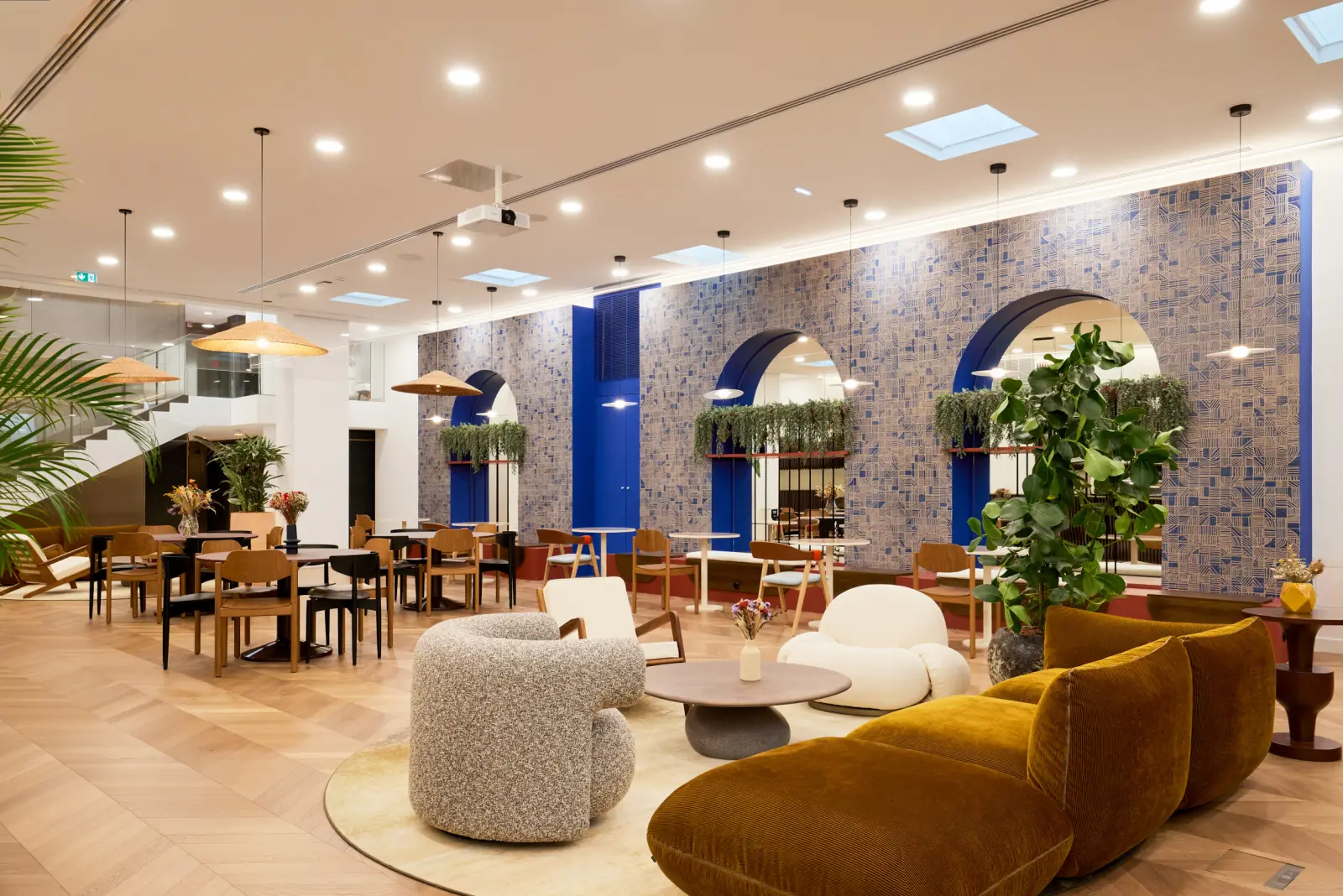
Coworking has become a credible alternative to the traditional commercial lease for housing a team over the past decade. Beyond the image of a shared space for freelancers, companies of 5 to 100 people now base some or all of their staff there. The benefits of coworking rest on five main levers: contract flexibility, cost control, the environment offered to teams, the effect on employer brand, and access to a professional network. They come with real limits, detailed at the end of this article.
The coworking market in figures for 2026
Before detailing each benefit, a quick look at the market explains why coworking now weighs on companies’ real estate decisions.
| Indicator | 2026 figure | Reading |
|---|---|---|
| Number of coworking spaces in France | More than 3,400 | Market stabilised after a decade of growth |
| Paris region share of national supply (floor area) | Around 35% | Still the densest region, despite a declining relative share |
| Entry price for a desk, Morning Paris | From €280 excl. tax / month | Open space desk, no long-term commitment |
| Private office desk, Paris median | €535 / month | Market benchmark across all zones |
Market data compiled in 2026 from industry observatories (Flash Office) and operators’ public pricing grids.
The French coworking market grew by 23% between 2023 and 2024 before stabilising at around 3,400 spaces. The Paris region still holds roughly a third of national supply by floor area, but mid-sized cities, led by Lyon, Bordeaux, Nantes, Lille and Toulouse, are densifying their coworking offer rapidly.

Contract flexibility, the first benefit of coworking
A traditional commercial lease in France ties a company down for nine years, with an exit option every three years, hence its nickname, the “3-6-9” lease. Coworking works on a fundamentally different model: a service agreement, cancellable with one to three months’ notice depending on the operator.
This flexibility changes the nature of the real estate decision. A team that doubles in size within a year can change space or add desks without waiting for a lease to expire. Conversely, a slowdown does not lock the company into an oversized space for several years.
A commitment matched to the company’s cycle
- Early-stage startup: a handful of desks, monthly commitment, to preserve cash.
- Scale-up in growth mode: scaling up by batches of 5 to 10 desks, without renegotiating a lease at every step.
- Regional branch or subsidiary: testing a location before committing to a long lease, a logic covered in the guide on where to locate offices in Paris .
Controlled costs compared with a traditional office
The second benefit lies in the very structure of the cost. A commercial lease requires a security deposit of several months’ rent, fit-out works charged to the tenant, and fixed charges regardless of the offices’ actual occupancy rate. Coworking bundles most of these costs into a known, per-desk price.
| Cost item | Traditional commercial lease | Coworking |
|---|---|---|
| Security deposit | 3 to 6 months’ rent | None, or a reduced deposit |
| Fit-out works | Charged to the tenant | Included |
| Furniture and equipment | Charged to the tenant | Included |
| Meeting rooms | Often billed separately | Included or bundled in hour packs |
| Minimum commitment | 3 years (“3-6-9” lease) | 1 to 12 months depending on the operator |
A detailed, district-by-district breakdown is available in the comparison of coworking prices in Paris , which shows gaps of more than double depending on the area.
A working environment that shapes employee wellbeing
The third benefit does not show up on an invoice, but it has become decisive since remote work went mainstream. The pace has settled at around 1.9 days of remote work per week, and companies trying to bring teams back cite relational reasons first: 38% mention recruitment, 33% engagement, 23% limiting departures.
Coworking answers three of those points without resorting to constraint:
- It breaks the isolation of working from home. An employee working alone five days out of seven loses the informal link with their team; a shared space restores that collective setting without forcing a return to head office.
- It shortens commutes. For a colleague living far from head office, or in a small flat, a desk close to home removes an hour of daily travel without sacrificing working conditions.
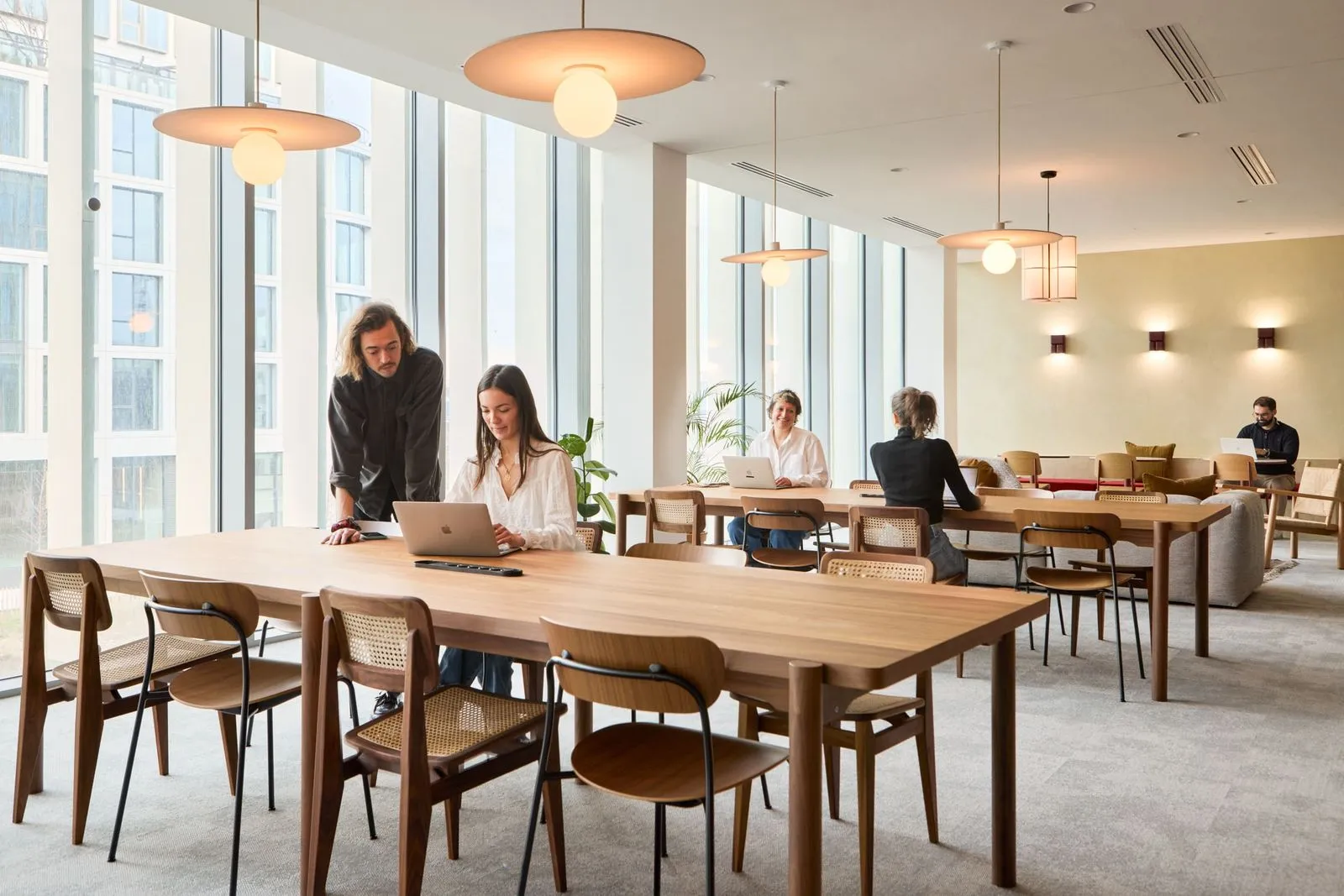
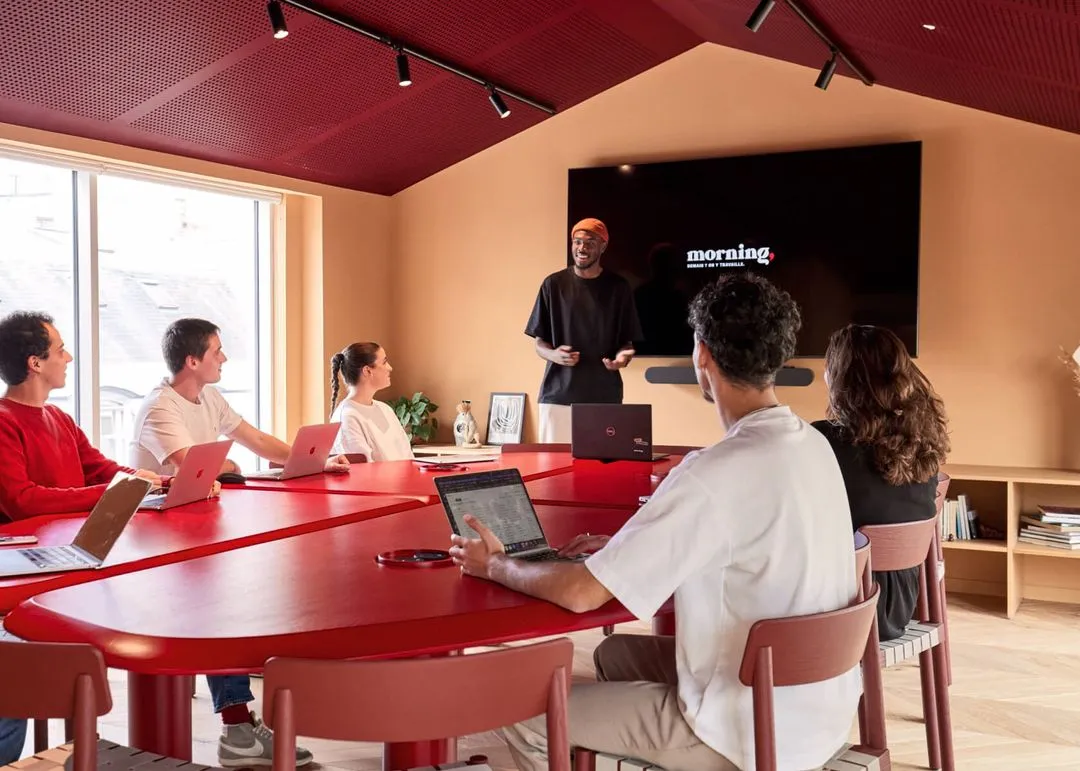
- It offers spaces the home does not have: closed rooms for calls, proper furniture, reliable connectivity, and focus areas kept separate from collaboration areas.
That last point deserves particular attention. In open environments, 71% of people say noise disrupts their concentration: the benefit only exists if the space offers genuine alternatives to open plan. This is exactly the subject of our guide on how to bring employees back to the office , where the quality of the place matters more than the number of days imposed.
Employer brand and multi-city presence
The fourth benefit is strategic. Offering flexible addresses sends a signal about how a company views work, a criterion that has become visible in recruitment. It connects directly to the office design trends for 2026 , where floor space contracts while the variety of settings increases.
Above all, it opens an option that is hard to obtain otherwise: opening a branch in a new city without tying up capital. A few desks in a local coworking space allow a company to test a market, host a first salesperson, or retain a rare profile who refuses to relocate. If the market does not take off, exiting costs a notice period, not a lease assignment.
A professional network powered by shared spaces
The fifth benefit, less often quantified but regularly cited by companies, is access to a wider professional network. Large community spaces, such as the Morning Bourse address which brings together more than 400 professionals under one roof, put startups, freelancers and large corporates in the same building, people who would not otherwise have crossed paths.
This sharing produces three concrete effects:
- Business opportunities between members of the same space, encouraged by events run by the operator.
- Easier recruitment, with some profiles sourced through co-optation within the community.
- Informal market intelligence, particularly useful for product and tech teams based in startup-dense districts.
An effect that varies with community size
The intensity of this benefit depends directly on the size and activity of the space. A 20-desk space on the outskirts does not deliver the same networking effect as an address hosting several hundred professionals in the heart of a business district. This is worth checking before signing, alongside the number of available meeting rooms.
Coworking and flex office: two complementary levers
Coworking combines naturally with a flex office organisation, where employees have no fixed desk. A company can reduce its fixed private office space and cover occasional needs with coworking desks, during an activity peak or when hosting a temporary project team.
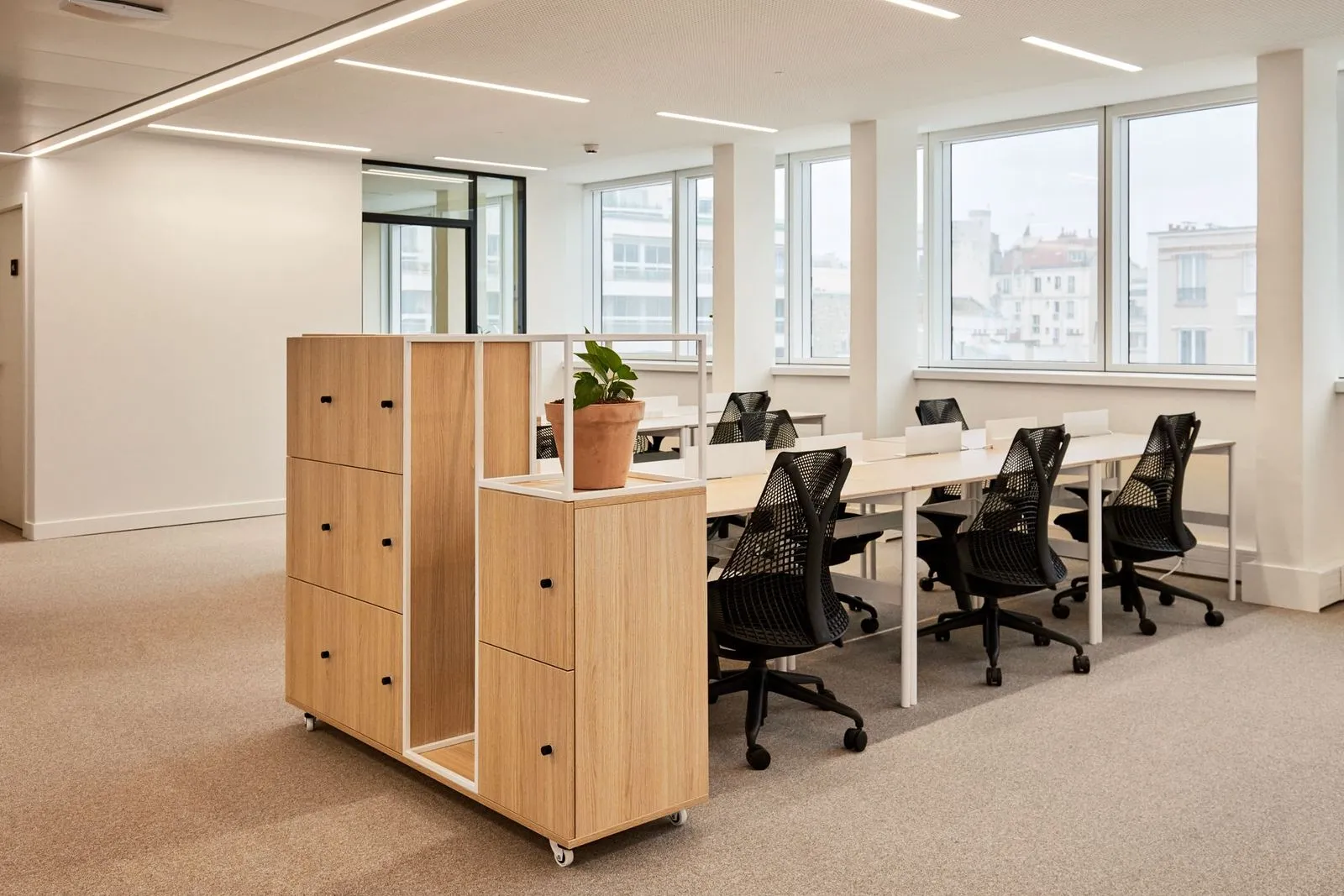
This combination also feeds into the choice between private office and open space : open space coworking suits individual tasks and informal exchanges, while a private office, available in most coworking spaces, remains reserved for activities that require confidentiality.
The drawbacks of coworking to know before choosing
Coworking is not a universal solution, and comparisons that list only the upsides miss most of the decision. Four limits come up repeatedly in company feedback:
- Cost per desk rises with headcount. Beyond 50 to 80 desks, a traditional private floor or a flexible lease often becomes more competitive than a large volume of coworking desks.
- Confidentiality remains limited in open space. Sensitive discussions require booking a private office or a closed room, adding a variable cost to the monthly budget.
- Noise remains the leading source of dissatisfaction. With 71% of people in open environments citing it as a barrier to concentration, a space without phone booths or quiet zones cancels part of the expected benefit.
- Availability depends on the district. In Paris’s most sought-after areas, the best floors get booked several weeks in advance, a point worth anticipating before any relocation project.
None of these limits is a deal-breaker, but each one is checked before signing, not after moving in.
How to choose a coworking space
Three criteria help make the choice objective, beyond the networking effect and the headline price:
- The number of addresses the operator has in the target district, which determines the ability to change site without leaving the area in case of growth.
- The services bundled into the per-desk price: meeting rooms, phone booths, gym access, mail handling.
- The minimum commitment period and notice for leaving, which determine how reversible the decision really is.
For a company of 1 to 50 people, coworking remains the strongest compromise between contract flexibility, controlled cost, quality of environment and access to a professional network, provided the density of addresses and the quality of the operator’s services are checked before signing.